Welcome to the home of Primary Healthcare Based Universal Health Coverage, UHC. We promote universal health coverage in Nigeria
We set out to move Universal Health Coverage from Policy to People. We set out to enrol people household by household for UHC
Through Membership of Mutual Health Association
For more than two decades, the leadership behind Healthcare Access Covenant Foundation has contributed to Nigeria’s Universal Health Coverage (UHC) movement through research, policy engagement, and published work on health financing and reform. Healthcare Access Covenant Foundation (HAC) now has been established to translate Universal Health Coverage from national policy aspiration into structured, community-level implementation. We align our work with Nigeria’s health sector reform agenda, the mandate of the National Health Insurance Authority, and the global UHC principles advanced by the World Health Organization. We make attainment of Sustainable Development Goal 3 our strategic goal. Our focus begins in Ekiti State, with the ambition to develop a scalable model for Southwestern Nigeria. This can be franchised to cover entire Nigeria.
We are Moving Universal Health Coverage from Policy to People. Whoever doctors cannot reach, AI assisted Community Health Workers can reach them.
Welcome to Ekiti State, where the indigenes need help to build a resilient, sustainable health system for themselves
We want to ensure that the mother in rural Ekiti has the same access to equitable, evidence based primary health care as those in our national policy papers.
We want to ensure that vulnerable people are not subjected to catastrophic out-of-pocket medical expenditures as envisaged in the federal government policy papers.
We want to bridge the gap between national policy and rural dwellers by making every one of them to join a Mutual Health Association in their immediate neighbourhood so that Primary Healthcare services can be delivered to them neighourhood by neighborhood.
Help Ekiti People To Help Themselves
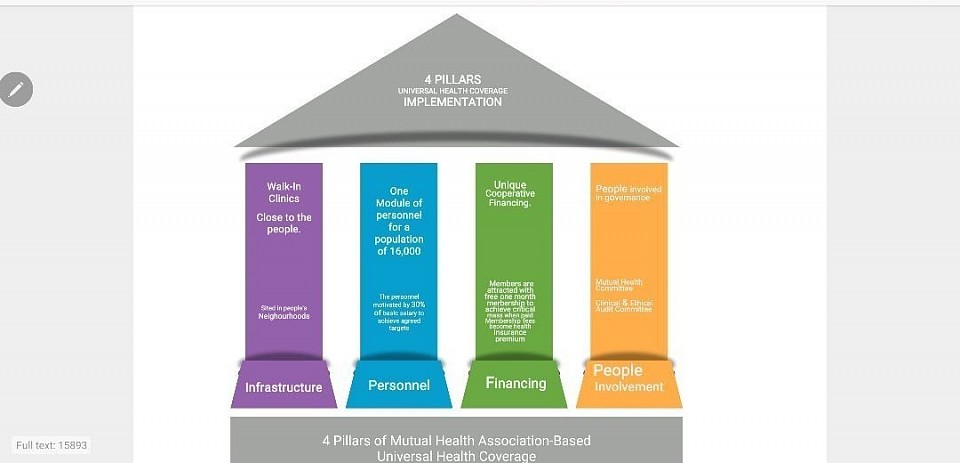
Our 4 Strategic Pillars
Welcome to Our 4-Pillar Unique Approach
Our unique approach is to combine four mechanisms of a health system: health infrastructure, health personnel, health financing, people involvement, into a Modular System that is sustainable, scalable and population focused.
We combine the following processes into an integrated Modular health system:
i, health financing, using membership contributions of Mutual Health Associations, operating as a cooperative organisation with a pre-paid health insurance premium,
ii, delivering health services using Modules of health personnel consisting of Community Key Workers, nurses and doctors, who are Task Sharing and Task Shifting, and having responsibility for a specified number of people,
iii, operating Open Walk-In AI Clinics in people's neighbourhoods
iv, involving local members of the community in several respects: In governance as members of Mutual Health Association Committees, as members of Clinical and Ethical Committees, in healthcare delivery by retired health personnel, or in social support by transporting ill people from the Clinics to hospitals, if necessary.
In this health system, the role of the people extends beyond going to the clinic for treatment. The system is designed to engender people ownership.
The data base of the enrolled members provide an anonymous fertile sample population for clinical and epidemiological research.

Our RuralMind Mutual Medical AI will assist Doctors to reach more people in rural communities
Solar-Powered. AI-Assisted Mutual; Our Community-Owned, Mutual Medical Clinic, is bringing healthcare to the Last Mile.
The Problem We Are Solving
In rural Ekiti State, the nearest primary healthcare facility can be two to three hours away. Community health workers operate without diagnostic tools. Mothers deliver without skilled attendance. Hypertension and diabetes go undetected for years. Malaria kills children who could have been treated in hours.
This is not a failure of medicine. It is a failure of access to medicine.
RuralMind Mutual Clinic: The AI Clinics that provide answers.
A RuralMind AI Clinic is a solar-powered, AI-assisted diagnostic and consultation unit deployed directly inside rural communities, in the village square, in the community neighbourhood by neighbourhood where people already live.
Our Hub-and-Spoke facilities have spoke clinics in rral areas linked to hub clinics at the centre. This brings together four technologies that individually exist, but have never been integrated at scale for rural Nigeria:
🤖 Artificial Intelligence Clinical Decision Support
An AI system guides trained Community Health Workers through patient triage, symptom assessment, and treatment protocols for the most common conditions in our communities — malaria, hypertension, diabetes, respiratory illness, and maternal health. It works offline, without internet connectivity. This is linked to the facility in the centre where patients can be referred.
🔬 Point-of-Care Diagnostics
Each clinic unit is equipped with portable diagnostic tools for malaria rapid testing, blood glucose measurement, blood pressure monitoring, urinalysis, and basic haematology — integrated directly with the AI platform so results inform clinical decisions in real time and triagging as indicated.
📡 Telemedicine Connectivity
When the AI flags a case that requires a qualified doctor, the system connects the community health worker and patient — live — to a physician at a hub of our faciities. No patient is left without access to medical expertise.
☀️ Solar Power
Every RuralMind Mutual Clinic is fully off-grid. Powered entirely by solar energy, it operates independently of Nigeria's electricity grid. No generator. No fuel costs. No interruption of care.
How It Works
Step 1 — A Hub-and-Spoke network of WWalk-In primary health care centres are set up all over the State. The main Hub is in Ado-Ekiti. The Spokes are clinics in rural areas and deprived urban areas
Step 2- Community Health Worker Activation
A trained Community Health Worker opens the spoke RuralMind Mutual Clinic at a scheduled clinic time. This offers Walk-In primary healthcare services.
Step 3 — AI-Guided Triage
The health worker enters the patient's symptoms into the AI interface. The system asks structured follow-up questions, analyses the pattern against clinical protocols, and recommends a course of action — from treatment at community level to urgent referral.
Step 4 — Diagnostics
Point-of-care tests are conducted where indicated. Results are captured automatically by the system. The doctor at the hub has immediate access to the results.
Step 5 — Treatment or Referral
The health worker follows the AI-recommended protocol, dispensing essential medicines within approved guidelines. If escalation is needed, a telemedicine call connects the patient to a registered nurse or a doctor, at the hub, immediately.
Step 6 — Record and Learn
Every encounter is recorded. Over time, the dataset strengthens the AI model — making it smarter, more locally calibrated, and more accurate for subsequent patients.
The database provides sampling frame for clinical epidemiological studies.
What Conditions Does It Address?
Pyrexia: Diagnosis and treatment
Malaria
Infections
Upper respiratory tract
Urinary tract
Hypertension — screening, monitoring, and medication management
Type 2 Diabetes — screening and glycaemic monitoring
Basic refractory errors for shortsightedness/long sightedness
Maternal health — antenatal screening and danger sign detection
Mental health — basic screening and psychosocial support referral
Communicable disease surveillance
Minor injuries
Childhood immunization
Tetanus Toxoid
Our Targets: Three Year Indicators
Target: 50 spoke RuralMind AI Clinics across Ekiti State
Patients reached annually: 200,000+ (Neighbourhood by Neighbourhood)
Community Health Workers trained: 200
Reduction in referral delays: 60%
Screening 100% of the population for high blood pressure and diabetes
Reduction in maternal mortality (project areas): 30%
Surveillance of population health to flag unusually common occurrences
Why We Are Different
Most rural health initiatives in Nigeria are built on outreach — a visiting team, a medical mission, a one-day medical camp, a temporary intervention. When the team leaves, the access gap returns.
RuralMind Mutual Health Association AI Clinics are permanent community infrastructure in rural areas. They are owned and governed by the community's own Mutual Health Association. They are financed through membership contributions, NHIA capitation payments, and institutional partnerships. They do not depend on donor goodwill to survive.
When we leave — the clinic stays.
Built for Replication
We are starting in Ekiti State. But we are building what Nigeria and Sub Saharan Africa can replicate.
Our full deployment toolkit covering hardware specifications, AI configuration, Community Health Worker training curriculum, and governance framework, will be openly published so that any organisation, state government, or community group can replicate this model without starting from scratch.
This is not a pilot. It is a prototype for universal replication.
We Align With Nigeria's Health Framework
RuralMind Mutual AI Clinics operate within and strengthen existing national systems:
National Health Insurance Authority (NHIA) — enrolled members qualify for capitation-based payments.
Basic Health Care Provision Fund (BHCPF) — state-level co-financing mechanism.
Technology Stack
Components. Platform. Cost Model
1, Electronic Medical Record. Medplum (Cloud-hosted) Available Free Tier
2, Patient Communication. Twilio. (SMS+Whatsapp). Pay-per-message
3, Automotive Middleware. Make (Integromat). Free, single clinic
4, AI Clinic Support. Claude/GPT-4o API. Pay-as-go
5, AI Transcription OpenAI Whisper API. Pay-as-go of audio
6, Appointment scheduling Calendly. Available Free tier
7, Patient Data Form. KoboToolbox. Free to NGO/health
All platforms are cloud-based.
We Are Professionals
Our team have pre-requisite registrations:
Nigeria Community Health Practitioners Registration.
All Community Health Workers are registered and operate within their legally defined scope of practice
Nurse Council of Nigeria for nurses
Medical and Dental Council of Nigeria for doctors
Partner With Us
RuralMind Mutual AI Clinics represent an investment opportunity for:
State and federal government agencies
Impact investors and development finance institutions
Philanthropic foundations
Diaspora donors committed to health equity in Nigeria
To discuss partnership, piloting, or funding, contact us at:
🌐 www.healthaccesscovenant.org/contact.html
PRIMARY HEALTHCARE-BASED UNIVERSAL HEALTH COVERAGE
Universal Health Coverage From Policy to People.
Healthcare Access Covenant Foundation (HAC) is developing a community-based model for translating Universal Health Coverage from national policy into practical access to quality, affordable primary healthcare at household and community level.
Our approach brings together community participation, Mutual Health Associations, pooled health financing, primary healthcare, community health workers, referral systems and appropriate digital technology into one connected healthcare ecosystem.
Household by household. Community by community.
[HOW THE HAC MODEL WORKS]
[PARTNER WITH HAC]
THE UHC CHALLENGE
Universal Health Coverage is more than having a health policy.
For Universal Health Coverage to become a reality, people must be able to obtain the healthcare they need without suffering financial hardship.
Yet many households continue to face barriers including:
Financial Barriers
The cost of healthcare can prevent people from seeking care early or expose families to financial hardship.
Limited Access
Many rural and underserved communities remain insufficiently connected to quality primary healthcare.
Fragmented Care
Patients may struggle to navigate between community services, primary healthcare facilities and higher levels of care.
The Last-Mile Gap
A national UHC policy does not automatically translate into healthcare access for an individual household.
The question is not whether Nigeria needs Universal Health Coverage.
The question is how we take UHC from policy to the household.
OUR ANSWER
Primary Healthcare-Based Universal Health Coverage
HAC believes that Universal Health Coverage should be built around strong primary healthcare, community participation and sustainable health financing.
Our model is designed to connect households to primary healthcare through community-based financing and organised healthcare networks.
ACCESS
Bringing essential healthcare closer to households and communities.
FINANCING
Pooling community contributions so that the financial burden of illness is shared rather than carried alone.
PRIMARY HEALTHCARE
Making primary healthcare the first and most accessible point of contact with the health system
CONTINUITY
Connecting community services, primary healthcare, referral care and follow-up into a continuous pathway.
COMMUNITY OWNERSHIP
Giving communities a meaningful role in organising, financing and sustaining their healthcare.
HOW THE HAC MODEL WORKS
From the Household to Universal Health Coverage
HAC brings together several components that are often treated separately.
HOUSEHOLDS
↓
MUTUAL HEALTH ASSOCIATION
↓
COMMUNITY CONTRIBUTIONS
↓
POOLED HEALTH FUND
↓
PRIMARY HEALTHCARE NETWORK
↓
HAC HUB + COMMUNITY SPOKES
↓
COMMUNITY HEALTH WORKERS
↓
REFERRAL WHEN NECESSARY
↓
CONTINUITY & COMMUNITY FOLLOW-UP
↓
UNIVERSAL HEALTH COVERAGE AT COMMUNITY LEVEL
The result is a model designed to connect people, financing and healthcare delivery rather than treating them as separate systems.
THE COMMUNITY IS PART OF THE FINANCING SOLUTION
Mutual Health Associations
At the heart of the HAC model is the Mutual Health Association.
A Mutual Health Association brings households together around a shared commitment to healthcare. Members make agreed contributions into a pooled health-financing arrangement that helps provide access to defined healthcare services.
Instead of waiting until an individual becomes ill and then expecting the household to bear the full cost, the community participates in risk pooling and collective health financing.
Member 1
Contribution
Member 2
Contribution
Member 3
Contribution
Member 4
Contribution
↓
COMMUNITY HEALTH FUND
↓
HEALTHCARE FOR MEMBERS WHEN NEEDED
This approach is based on a simple principle:
Everyone contributes. Those who need care receive care. The community shares the financial risk.
The Mutual Health Association therefore becomes more than a financing mechanism. It can also provide a platform for community participation, health education, accountability and collective action for better health.
HOW COMMUNITY CONTRIBUTIONS SUPPORT HEALTHCARE
From Contribution to Care
The HAC model is designed to connect financing directly with healthcare delivery.
MEMBER CONTRIBUTIONS
↓
POOLED COMMUNITY HEALTH FUND
↓
PRIMARY HEALTHCARE SERVICES
↓
REFERRAL SERVICES WHEN NECESSARY
↓
COMMUNITY FOLLOW-UP
↓
MONITORING & ACCOUNTABILITY
The objective is to create a transparent relationship between what communities contribute and the healthcare services they can access.
HAC's approach is intended to strengthen financial protection while supporting greater utilisation of appropriate primary healthcare.
THE HAC PRIMARY HEALTHCARE NETWORK
Bringing Healthcare Closer to Every Community
A central component of the HAC model is a Hub-and-Spoke Primary Healthcare Network.
The model connects a central healthcare hub with community-level healthcare points and community health workers, creating a structured pathway between households, primary healthcare and referral services.
REFERRAL HOSPITAL
↑
|
┌────────┴────────┐
│ HAC HUB │
│ │
│ Primary Care │
│ + Coordination │
└───────┬────────┘
│
┌─────────────────┼─────────────────┐
↓ ↓ ↓
SPOKE 1 SPOKE 2 SPOKE 3
↓ ↓ ↓
Community Community Community
Health Workers Health Workers Health Workers
↓ ↓ ↓
HOUSEHOLDS HOUSEHOLDS HOUSEHOLDS
The Hub
The hub provides a stronger primary healthcare base, coordination, clinical support, referral coordination and other functions required to support the network.
The Spokes
Spokes extend healthcare closer to communities and households, helping to overcome geographical and access barriers.
Community Health Workers
Community health workers provide an important link between households and the formal healthcare system.
Referral Hospitals
Patients requiring services beyond the capacity of primary healthcare can be referred to appropriate secondary or tertiary facilities.
TAKING PRIMARY HEALTHCARE THE LAST MILE
Community Health Workers
A health system cannot achieve UHC if people remain disconnected from it.
Community health workers can help bridge the gap between households and healthcare facilities.
Their roles may include:
FIND
Identifying households and people who may need healthcare, prevention or health information.
CONNECT
Connecting individuals and families to appropriate primary healthcare services.
EDUCATE
Supporting health education, prevention and healthy behaviours.
SUPPORT
Helping people navigate the healthcare system and encouraging appropriate care-seeking.
FOLLOW UP
Supporting continuity of care after facility-based treatment.
Through this community-level connection, HAC aims to bring primary healthcare closer to the people who need it most.
TECHNOLOGY THAT SUPPORTS PRIMARY HEALTHCARE
Extending the Reach of the Health System
Appropriate digital and AI-enabled technologies can strengthen the ability of community health workers and primary healthcare teams to reach underserved populations.
Within the HAC model, technology can support areas such as:
Community-level health information
Patient registration and enrolment
Health education
Early identification of health needs
Referral coordination
Follow-up and continuity of care
Data collection and reporting
Health-system monitoring
Technology is intended to support—not replace—healthcare professionals and community health workers, with appropriate clinical oversight, governance and protection of patient information.
FROM YOUR HOME TO THE RIGHT LEVEL OF CARE
A Connected Patient Journey
01 — HOUSEHOLD
A person or family member needs healthcare.
↓
02 — COMMUNITY HEALTH WORKER
The community health worker provides appropriate support and connects the household to care.
↓
03 — PRIMARY HEALTHCARE
The patient receives appropriate first-contact healthcare through the PHC network.
↓
04 — REFERRAL
If a condition requires a higher level of care, the patient is referred.
↓
05 — HOSPITAL / SPECIALIST CARE
The patient receives the appropriate secondary or tertiary service.
↓
06 — COMMUNITY FOLLOW-UP
The patient returns to the community and receives appropriate follow-up and continuity of care.
The objective is not simply to build more facilities.
It is to build a connected healthcare pathway around the patient.
UHC BEGINS BEFORE PEOPLE BECOME SERIOUSLY ILL
Prevention, Early Detection and Primary Care
Primary healthcare should not only treat illness. It should help communities prevent illness, detect problems early and maintain better health.
PREVENTION
Health education, vaccination, risk reduction and other preventive interventions.
EARLY DETECTION
Identifying health problems before they become more serious.
PRIMARY TREATMENT
Providing accessible, appropriate first-contact healthcare.
CONTINUITY
Supporting patients beyond the initial consultation or treatment.
WHAT MAKES THE HAC MODEL DIFFERENT?
Moving From Policy to Implementation
Traditional approach
HAC approach
Policy-led
Policy translated into community-level implementation
Facility-centred
Household + community + facility
Individuals bear healthcare costs when sick
Community-based risk pooling
PHC and financing operate separately
Financing linked to primary healthcare
Patients navigate the system alone
Community health workers help connect households
Referral can be fragmented
Structured referral and follow-up
UHC measured mainly at system level
UHC translated into household-level access
From measuring coverage...
...to making coverage real.
WHY MUTUAL HEALTH?
Community-Based Health Financing
HAC's Mutual Health Association approach is designed around several principles:
COLLECTIVE RESPONSIBILITY
Members contribute together towards a shared health objective.
RISK POOLING
The financial impact of illness is shared across the membership.
LOCAL OWNERSHIP
Communities participate in organising and sustaining their healthcare system.
FINANCIAL PROTECTION
Members have a mechanism designed to reduce the burden of unexpected healthcare costs.
ACCESS
Financing is linked to access to defined healthcare services.
ACCOUNTABILITY
Community participation creates opportunities for greater transparency and accountability.
WHY PRIMARY HEALTHCARE?
Because UHC Starts With First Contact
Primary healthcare is where most people's interaction with the health system should begin.
Strong PHC can provide:
Prevention
Health promotion
Basic diagnosis and treatment
Maternal and child health services
Immunisation
Management of common conditions
Chronic disease support
Community health services
Referral to higher levels of care
HAC's model therefore places primary healthcare at the centre of its approach to Universal Health Coverage.
STARTING IN EKITI STATE
Demonstrating the Model in Nigeria
HAC is developing its Primary Healthcare-Based UHC model in Ekiti State, Nigeria.
Ekiti provides an opportunity to demonstrate how community participation, health financing and primary healthcare strengthening can be brought together in a practical UHC implementation model.
The experience generated in Ekiti can provide evidence and lessons for adaptation and expansion in other communities and states.
FROM EKITI TO NIGERIA
A Model Designed to Scale
EKITI STATE
↓
LOCAL GOVERNMENT AREAS
↓
SOUTHWEST NIGERIA
↓
NIGERIA
HAC's ambition is not simply to operate a successful healthcare project in one location.
Our ambition is to demonstrate a practical, evidence-informed model that can be adopted, adapted and scaled.
The model is designed to evolve with the needs of communities, government health systems and healthcare partners.
MEASURING SUCCESS
How Will We Know the Model Is Working?
HAC intends to monitor outcomes across several dimensions of UHC.
COVERAGE
Households and individuals enrolled.
ACCESS
Use of appropriate primary healthcare services.
FINANCIAL PROTECTION
Reduction in the financial burden associated with healthcare.
QUALITY
Quality and continuity of healthcare services.
EQUITY
Reach among rural, underserved and vulnerable communities.
HEALTH OUTCOMES
Selected health and population-health indicators.
SUSTAINABILITY
Performance of community health financing and healthcare delivery mechanisms.
COMMUNITY OWNERSHIP
Strength and participation of Mutual Health Associations.
BUILDING EVIDENCE FOR UNIVERSAL HEALTH COVERAGE
From Implementation to Learning
HAC sees implementation and research as complementary.
RESEARCH
Generate evidence about community health financing, primary healthcare and UHC.
IMPLEMENTATION
Test the model in real communities.
LEARNING
Use evidence and community feedback to improve the model.
SCALE
Translate successful approaches into models that can be adapted elsewhere.
Our objective is not simply to implement a programme.
We aim to build evidence about what works—and how it can work at scale.
UHC CANNOT BE ACHIEVED ALONE
Partner With HAC
Achieving Universal Health Coverage requires collaboration between communities, governments, healthcare providers, researchers, technology partners and development organisations.
GOVERNMENTS
Partner with HAC to strengthen community-level implementation of UHC and primary healthcare.
DEVELOPMENT PARTNERS
Support evidence-based approaches to health financing, PHC access and financial protection.
COMMUNITIES
Organise households and participate in Mutual Health Associations.
HEALTHCARE PROVIDERS
Participate in an integrated primary healthcare and referral network.
TECHNOLOGY PARTNERS
Support responsible digital transformation of community and primary healthcare.
FUNDERS
Support demonstration, evaluation and scale-up of the model.
Let's move Universal Health Coverage from policy to people.
[PARTNER WITH HAC]
FOR COMMUNITIES
Affordable Healthcare Starts With a Connected Community
HAC is working to create a system in which communities can participate in organising, financing and accessing primary healthcare.
Interested in joining a Mutual Health Association?
[LEARN HOW TO JOIN]
[FIND A HAC LOCATION]
OUR VISION
Universal Health Coverage Does Not Begin at the Ministry.
It begins with the household.
HAC is working to move Universal Health Coverage from policy to people—household by household, community by community.
HEALTHCARE ACCESS COVENANT FOUNDATION
Primary Healthcare | Community Financing | Mutual Health | Universal Health Coverage | Evidence | Innovation
Nigeria • Ekiti State
[PARTNER WITH HAC]
[CONTACT HAC]
Message From The Founder
"Moving from the Library to the Village Square"
For over two decades, I have watched from the halls of academia as Health For All passed Nigeria by; as Nigeria failed to achieve any of the millennium development goals and as Universal Health Coverage, UHC, movement appears to be stagnating until a robust national mandate breathed life into it. With this new momentum, a question keeps haunting me: When will the mother in the rural settlement feel the impact of these policies?
Healthcare Access Covenant Foundation (HAC) is my answer to that question.
We are not here to reinvent the wheel. We are here to make it turn . We are in pursuit of Sustainable Development Goal 3.8. We espouse a solution to the last mile conundrum.
The challenge of the last mile is particularly stark in Ekiti despite a mandatory community health insurance scheme enacted into law in 2006. In Ekiti , we still see the life of a road traffic accident victim depending not on a functioning health system, but on the desperate, ad-hoc donations of his townsmen.
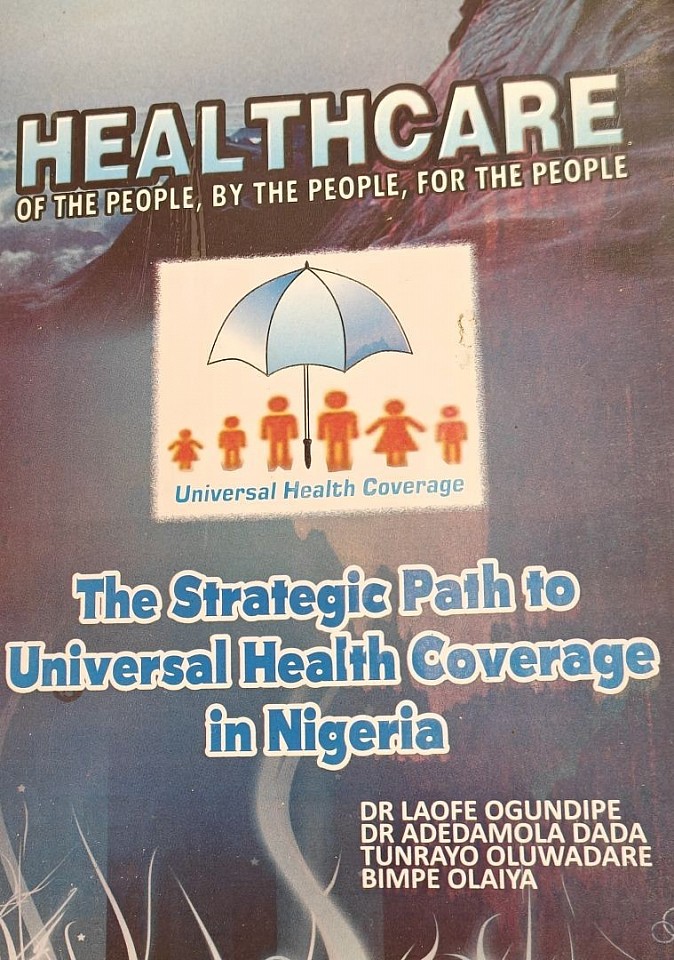
We have documented the solution to the "last-mile" conundrum: The Strategic Path to Universal Health Coverage in Nigeria (ISBN 9789789611731) and Financing Universal Health Coverage in Nigeria (ISBN 9789789613724). We are now mounting non-party partisan but practical steps to bring policy to the reality of remote men and women in Ekiti; To vulnerable poor people in Ekiti; To everyone living below poverty line in Ekiti.
We have chosen Ekiti State as our starting point—not just because of its intellectual heritage, but also because of the alluring characteristics of the people of Ekiti people. These coupled with the excellent but forgotten law on mandatory community health insurance scheme that requires all residents to belong to a contributory scheme, make Ekiti a perfect laboratory for a scalable and self-sufficient model of primary health care based universal health coverage that we espouse.
When we succeed in Ekiti, we provide a blueprint for all of Southwestern Nigeria, and indeed the whole of Nigeria.
Clarion call
We invite you to join us. Whether you are a policymaker, a retired health worker, a government official, a traditional ruler, a neighbourhood high chief, a philanthropist, a donor or a grant administrator, your partnership with us is the final ingredient in translating "Health for All" from a long term slogan into an immediate lived reality for every Nigerian.
Prof. Laofe Ogundipe, FRCPsych, London.
Founder, Healthcare Access Covenant Foundation